Ancient Cat Migrations: How Domestic Cats Spread from North Africa to Europe 2,000 Years Ago
The origins and European dispersal of domestic cats (Felis catus) have been traced in detail through ancient DNA analysis. A study analyzing 209 ancient cat specimens found that all domestic cats descend from the African wildcat (Felis silvestris lybica), first domesticated in the Near East 9,000–10,000 years ago. Two major dispersal waves followed: the first with Neolithic farmers (reaching Europe by 4400 BCE), and the second from Egypt along Roman Empire trade routes (1st millennium CE). The Egyptian-origin mitochondrial DNA haplogroup A was confirmed at the Viking trade port of Ralswiek, Germany, dated to 700–1000 CE.
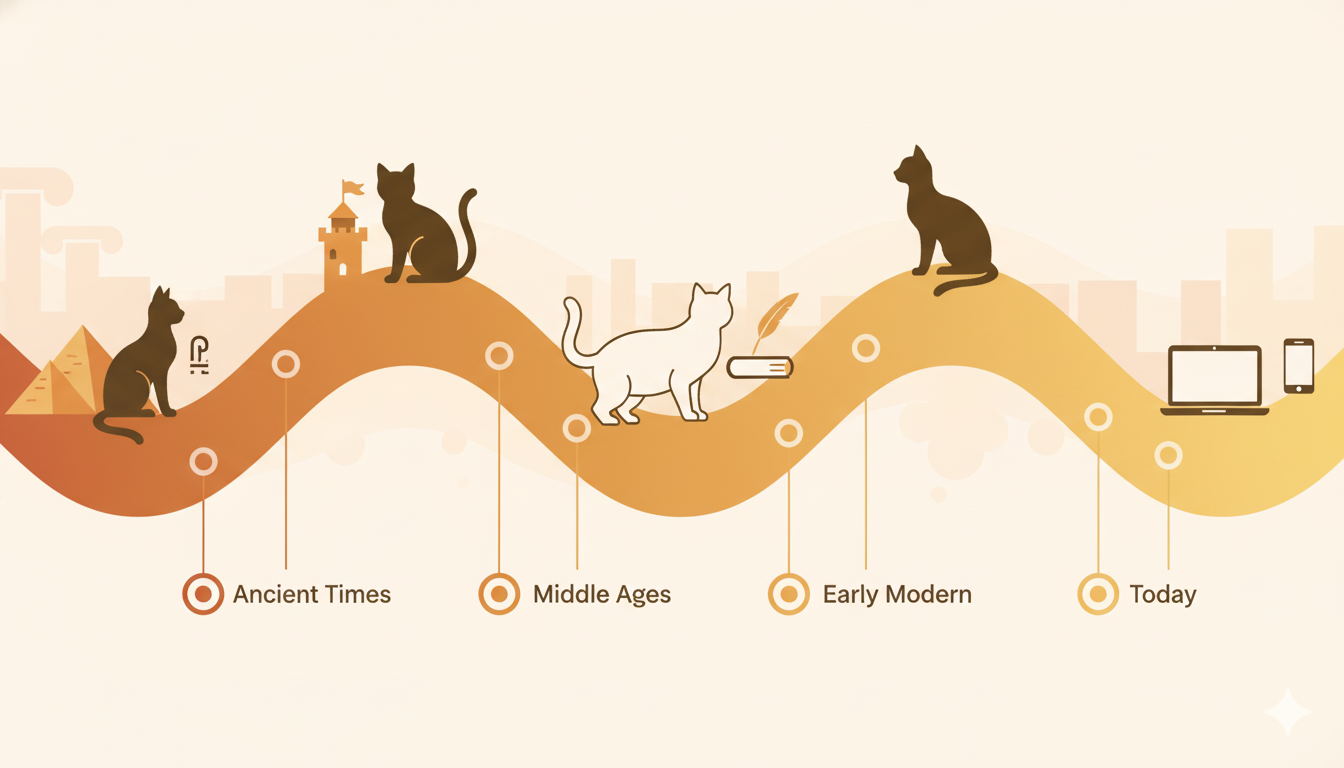
Research Background
고대 고양이 확산 연구는 고대 DNA(aDNA) 게놈 분석을 기반으로 한다. 근동, 북아프리카, 유럽 각지의 고고학 유적지에서 발굴한 고양이 골격 유물(신석기, 로마, 중세 시대)에서 DNA를 추출한다. Ottoni et al.(2017) 연구팀은 209개 고대 고양이 유골에서 미토콘드리아 DNA 일배체형(haplogroup)과 핵 단일 뉴클레오타이드 다형성(SNP)을 분석하고 현대 고양이 집단과 비교했다. 방사성탄소 연대 측정으로 유물의 시대를 확정하고, 계통발생수 재구성과 집단 이동 경로를 추정했다. 한계로는 고대 DNA의 열화, 오염 가능성, 유적지 분포의 불균형성이 있다.
Key Findings
- 1
All domestic cats (Felis catus) descend from the Near Eastern wildcat (Felis silvestris lybica) — first domesticated 9,000–10,000 years ago in the Near East
Source: PLOS Genetics, PubMed (PMC3586821)
- 2
209 ancient specimens reveal two dispersal waves: 1st with Neolithic farmers Near East→Europe (4400 BCE), 2nd from Egypt via Roman trade routes (1st millennium CE)
Source: Nature Ecology & Evolution (Ottoni et al. 2017)
- 3
Egyptian haplogroup A reached Viking trade port Ralswiek, Germany — confirmed 700–1000 CE, proving maritime trade route dispersal
Source: Nature Ecology & Evolution (Ottoni et al. 2017)
- 4
Cat remains from a Roman fort in Germany showed Near Eastern lineage (haplogroup C) — confirming domestic cats in Europe approximately 2,000 years ago
Source: PLOS ONE, PubMed (journal.pone.0047291)
- 5
Modern domestic cat diversity reflects these two ancient dispersal waves — varying proportions of Near Eastern and Egyptian lineages found across continents today
Source: PLOS Genetics, PubMed (PMC3586821)
How It Works
Ancient DNA analysis reveals cat dispersal through the molecular clock concept. Mitochondrial DNA (mtDNA) is inherited only maternally and does not recombine, enabling independent lineage tracking. DNA sequences accumulate random mutations over time due to replication errors or environmental factors, acting as molecular markers. Specific mtDNA haplogroups represent distinct maternal lineages — haplogroup A indicates Egyptian origin, haplogroup C indicates Near Eastern origin. Sequencing these markers from archaeological remains across different locations and time periods constructs phylogenetic trees. Greater genetic similarity between populations indicates more recent common ancestors or more frequent gene flow. Population genetics principles — genetic drift, gene flow, and the molecular clock hypothesis — allow inference of ancestral origins, migration routes, divergence times, and periods of population expansion.
What This Means for Cat Owners
Understanding the ancient origins of domestic cats helps owners better appreciate their companion's instinctive behaviors. Today's cats descend from North African desert wildcats, explaining their preference for warmth, efficient water conservation, and strong hunting instincts. A cat's independence and unique social dynamics reflect thousands of years of commensal co-evolution with humans. Use this knowledge to enrich your cat's environment — provide stimulating hunting-play activities, encourage hydration, and respect their subtle communication cues. Responsible ownership, including spaying/neutering and attention to genetic health, honors their rich evolutionary legacy.
Comparing the Two Major Cat Dispersal Waves
| Category | 1st Wave | 2nd Wave |
|---|---|---|
| Period | 4400 BCE (Neolithic) | 1st–10th century CE (Roman–Viking era) |
| Origin | Near East (modern Turkey/Iraq region) | Egypt |
| mtDNA Haplogroup | C | A |
| Driver | With Neolithic farmers (grain storage → pest control) | Roman Empire maritime trade routes |
| European Evidence | Roman fort in Germany (~2,000 years ago) | Viking port Ralswiek, Germany (700–1000 CE) |
| Modern Distribution | Worldwide (foundational lineage) | Mixed with Egyptian/Mediterranean lineage |
FAQ
Q. When and where were domestic cats first tamed?
A. Domestic cats were first tamed approximately 9,000–10,000 years ago in the Near East (modern Turkey, Iraq, Syria). As Neolithic farmers stored grain, rodent populations grew, attracting wild cats (Felis silvestris lybica) to hunt them. This commensal relationship gradually led to domestication, confirmed by genomic analysis in PLOS Genetics (PMC3586821).
Q. Why did Egyptian cats spread more widely across Europe?
A. Egypt was a central node in Roman Empire maritime trade. Cats aboard Roman ships spread throughout Mediterranean trade routes as pest controllers. They then traveled further via Viking trade networks. Ottoni et al. (2017) confirmed Egyptian haplogroup A in cat remains at the Viking port of Ralswiek, Germany, dated 700–1000 CE.
Q. Which lineage does my cat descend from?
A. Most modern domestic cats are descendants of a mix of both lineages. Asian cats tend to have higher proportions of Near Eastern lineage (haplogroup C), while European and Mediterranean cats lean toward the Egyptian lineage (haplogroup A). However, thousands of years of migration and interbreeding mean most cats carry both lineages. For breed-specific genetic origins, commercial pet DNA testing services can provide detailed ancestry information.
Journal: Nature Ecology & Evolution / PLOS Genetics / PLOS ONE (PubMed)
Year: 2026
Institution: Archaeological institutions across Europe, Near East, and North Africa